


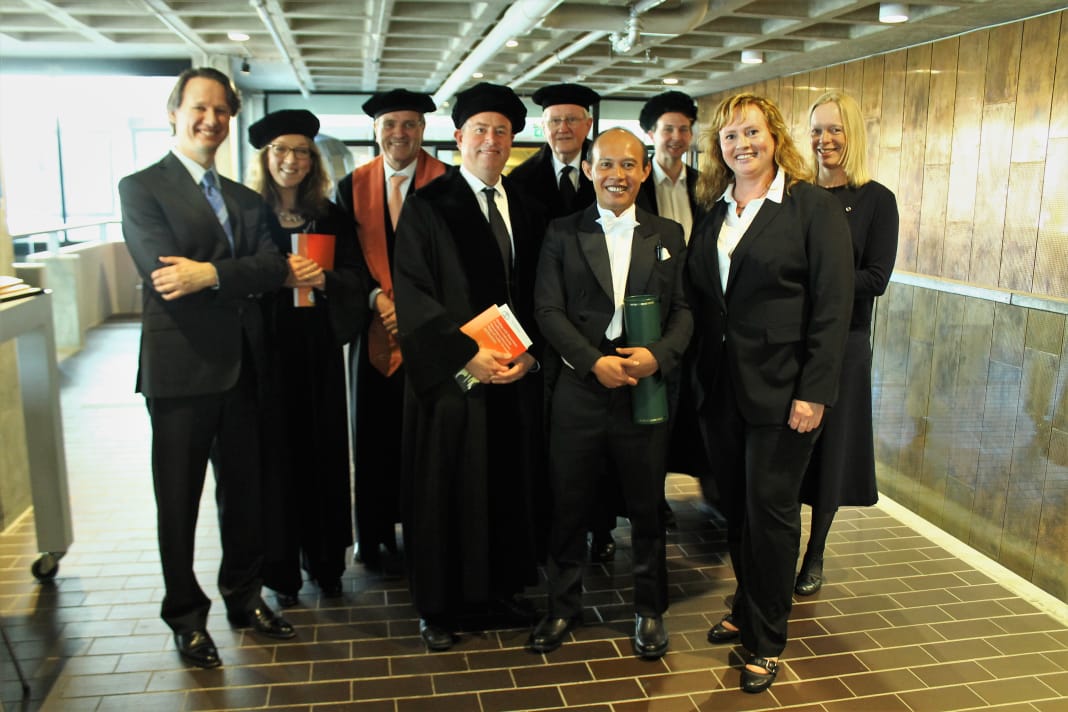
Berlokasi di Aula Vrije Universiteit (VU) Amsterdam, pada tanggal 10 April 2019, pukul 13.45, Ali Mashuri, S.Psi., M.Sc mempertahankan disertasinya berjudul ‘Dealing with Separatism Conflict in Indonesia: Examining an Interactive Model of Conflict De-escalation and Resolution’. Disertasi ini disupervisi oleh Prof. Mark van vugt (Promotor) dan Dr. Esther van Leeuwen (Co-promotor) dan dipertahankan dihadapan Tim Penguji yang terdiri dari:
- Prof. Marise Born, Honorary Professor in cross-cultural aspects of selection psychology, Department of Experimental and Applied Psychology, VU University (Chair).
- Dr. Jan-Willem van Prooijen, Associate Professor in Social Psychology, Department of Experimental and Applied Psychology, VU University.
- Prof. Henk van der Molen, Professor of Psychology, Erasmus University.
- Prof. Martijn van Zomeren, Professor of Social Psychology, University of Groningen.
- Dr. Nina Hansen, Associate Professor in Social Psychology, University of Groningen.
Dalam Ujian Terbuka Program Doktor Ilmu Psikologi Sosial di Faculty of Behavioural and Movement Sciences, VU University tersebut, Ali Mashuri, S.Psi., M.Sc dinyatakan lulus dan berhak meraih gelar Doctor of Philosophy (PhD).
Intisari dari disertasi Ali Mashuri, S.Psi., M.Sc dijelaskan dalam abstraksi sebagai berikut:
Separatist movements are a social phenomenon that spread in many countries across the world, threatening the stability of established political entities due to its violent and intractable nature. Deescalating conflict and establishing peace among the disputing parties is of paramount importance. Despite the pressing need, there is a notable dearth of social psychological research that has made reconciliation in such conflicts the focal point of its empirical investigation--and even less so pertaining to social-psychological interventions conducive to reconciliation. The aim of this dissertation was to address these gaps, offering an examination of the social-psychological factors and interventions that can promote reconciliation in separatist conflict.
The empirical studies presented in this dissertation assume that separatist conflicts involve two disputing parties harbouring contrary points of view: the majority that resists separatism and the separatist group that advocates its demand for autonomy. I investigated how majority and separatist groups alike think and feel about their involvement in conflict. Uncovering these perspectives has helped me through this dissertation in gaining a better insight into the social-psychological factors that facilitate or hinder support for reconciliation among the majority and separatist groups. This dissertation also examines the effectiveness of social-psychological interventions in attenuating the majority’s defensive reactions to its harm against the separatist group and, in turn, in promoting reconciliation among members of this non-separatist group. Finally, this dissertation confirms that the nature and the dynamics of reconciliation are complex. In this regard, I interpret reconciliation as a multidimensional construct that bears within it attitudinal, affective, intentional, and behavioural components, and assess the relations among these components.
This dissertation provides answers to several important research questions. Some limitations remain, however, raising new questions, and potential directions for future research have been outlined accordingly. I hope that by addressing these remaining gaps in our knowledge, follow-up studies will provide a more in-depth account concerning the underlying mechanisms of reconciliation in separatist conflict. These future studies can hopefully provide scholars and practitioners with further insight into social-psychological interventions that are effective in promoting reconciliation not only among members of the majority, which is the focus of this dissertation, but also among those of the separatist group.
Ali Mashuri, S.Psi., M.Sc., PhD adalah dosen ketujuh di Psikologi UB yang berhasil meraih gelar doktor.
Selamat datang dan selamat mengabdi dan berkarya kembali Ali Mashuri, S.Psi., M.Sc., PhD.
![[:id]Rapat Kerja 2017 Psikologi UB[:]](https://psikologiub.themastej.com/wp-content/uploads/2017/06/IMG_6394-1225x1080.jpg)
![[:id]Psikologi Juara Olimpiade FISIP UB 2017[:]](https://psikologiub.themastej.com/wp-content/uploads/2017/06/Olimpiade-FISIP-UB-2017.jpg)